Impedance matching PCB is the most critical foundation of signal integrity for high-speed electronic systems. This ultimate guide integrates IPC 2141A standards, Altium best practices, and industrial manufacturing knowledge to help engineers and global buyers master impedance control, reflection elimination, calculation methods, tolerance design, TDR testing, and real-world troubleshooting. Written for both professionals and beginners, this pillar content supports Google SEO ranking and genuine business inquiries for industrial high-speed PCB projects.
Table of Contents
- What Is Impedance Matching PCB
- Why Impedance Matching PCB Is Critical
- Characteristic Impedance (Z0) Fundamentals
- Standard Impedance Values for Impedance Matching PCB
- Key Factors That Control Impedance
- Signal Reflection & Impedance Mismatch
- Microstrip, Stripline & Differential Calculation
- Tools & Practical Calculation Examples
- Impedance Tolerance & Manufacturing Cost
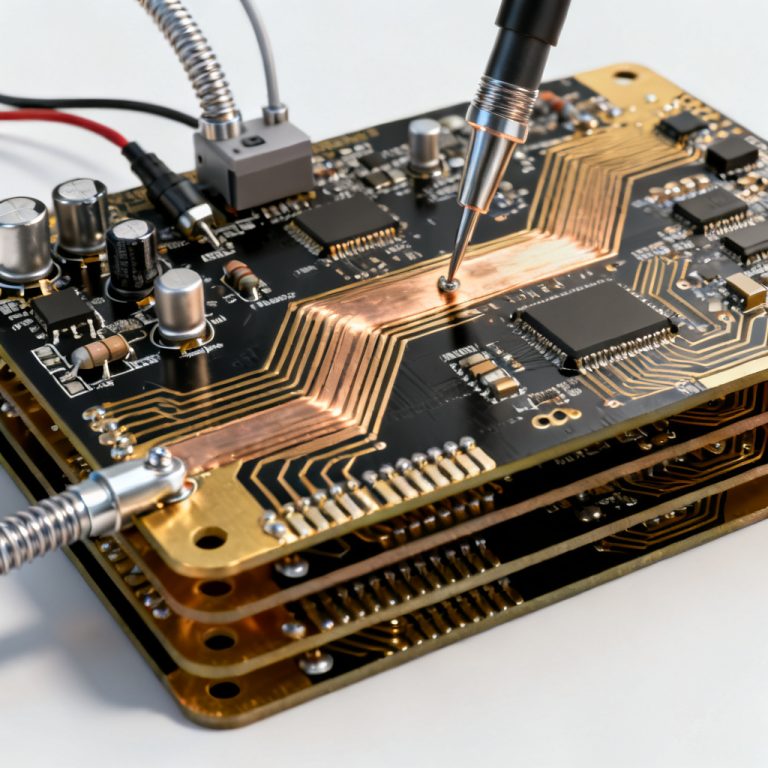
- How to Detect Impedance Mismatch
- TDR Waveform Interpretation
- Common Issues & Engineering Solutions
- IPC 2141A Standard Guidelines
- Frequently Asked Questions (FAQ)
- Key Takeaways
- Free Expert Support & Inquiry
What Is Impedance Matching PCB? Core Definition & Analogy
Impedance matching PCB is the core design technique that aligns the impedance of the signal source, transmission line, and load terminal to the same target value. The goal is to eliminate signal reflection and ensure stable, distortion-free transmission for high-speed signals.
When impedance is mismatched, high-speed electromagnetic waves reflect back from discontinuities, creating overshoot, undershoot, ringing, and electromagnetic interference (EMI).
A simple analogy: high-speed signals act like water flowing in pipes. If pipe diameters change suddenly, turbulence and splashing occur. Similarly, inconsistent impedance on PCB traces causes signal reflection and failure.
For a full framework of signal integrity, visit our official page: Signal Integrity Design.
Why Impedance Matching PCB Is Mandatory for High-Speed Designs
Impedance matching is not optional for high-speed systems—it is a required design rule. Without proper control, your PCB will face irreversible signal quality issues.
| Problem Caused by Mismatch | Impact on High-Speed Signals |
|---|---|
| Signal Reflection | Overshoot, undershoot, ringing, waveform distortion |
| Power Transmission Loss | Reduced signal amplitude and weak driving capability |
| Eye Diagram Closure | Higher bit error rate (BER), unstable logic |
| Increased EMI Radiation | Unwanted radiation, EMC test failure |
When Must You Use Impedance Matching PCB?
- Signal frequency above 50 MHz
- Signal rise time less than 6x transmission delay
- Trace length longer than 1/6 of the rise-time spatial wavelength
- High-speed interfaces: PCIe, Ethernet, USB 3.x, HDMI, DDR, 25G/56G/112G PAM4
Characteristic Impedance (Z0) Fundamentals
What Is Z0 in Impedance Matching PCB?
Characteristic impedance (Z0) is the instantaneous impedance that a high-speed signal encounters while traveling along a transmission line. It is measured in ohms (Ω).
Core formula:
Z0 = √(L / C)
Where L = inductance per unit length, C = capacitance per unit length.
Z0 is determined by physical structure, not trace length. This is why trace width, dielectric thickness, Dk, and copper weight directly determine impedance performance.
Standard Impedance Values for Impedance Matching PCB
The global industry uses fixed impedance standards to ensure compatibility across components, systems, and manufacturers.
| Impedance Value | Signal Type | Typical Applications |
|---|---|---|
| 50Ω | Single-ended | RF, clock lines, general high-speed signals |
| 75Ω | Single-ended | SDI video, broadcast systems |
| 90Ω | Differential | USB 2.0, USB 3.x |
| 100Ω | Differential | PCIe, Ethernet, HDMI, SATA, DDR |
Key Factors That Control Impedance in Impedance Matching PCB
| Physical Parameter | Impact on Z0 | Design Consideration |
|---|---|---|
| Trace Width (W) | Wider = Lower Impedance | Most frequently adjusted parameter |
| Dielectric Thickness (H) | Thicker = Higher Impedance | Controlled by layer stackup |
| Dielectric Constant (Dk) | Higher Dk = Lower Impedance | Determined by base material |
| Copper Thickness (T) | Thicker Copper = Lower Impedance | Critical for high-current designs |
Signal Reflection & Impedance Mismatch Theory
Reflection occurs at any impedance discontinuity, including vias, connectors, branch traces, pad transitions, and split ground planes.
Reflection Coefficient Formula
Γ = (Z2 − Z1) / (Z2 + Z1)
Where Z1 = incoming impedance, Z2 = next segment impedance.
| Impedance Relationship | Reflection Type | Waveform Effect |
|---|---|---|
| Z2 > Z1 | Positive Reflection | Overshoot |
| Z2 < Z1 | Negative Reflection | Undershoot |
| Z2 = Z1 | No Reflection | Ideal transmission |
Mismatch Tolerance & Practical Impact
| Impedance Deviation | Reflection Coefficient | Overshoot Level | Design Recommendation |
|---|---|---|---|
| ±5% | 0.025 | Negligible | Ultra-high-speed 112G PAM4 |
| ±10% | 0.05 | 5% of signal swing | Standard industrial choice |
| ±15% | 0.075 | 7.5% swing | Critical threshold |
| ±20% | 0.1 | 10% swing | Unacceptable, redesign required |
Calculation Methods for Impedance Matching PCB
Microstrip Impedance (Surface Layer)
Z0 ≈ 87 / √(Dk+1.41) × ln(5.98×H / (0.8×W + T))
Units: mils; Dk ≈ 4 for FR4.
Stripline Impedance (Inner Layer)
Z0 ≈ 60 / √Dk × ln(4×H / (0.67×π×W×(0.8 + T/W)))
Differential Impedance
Zdiff ≈ 2 × Z0 × (1 − k)
k = coupling coefficient; tighter coupling = lower differential impedance.
Tools & Calculation Examples for Impedance Matching PCB
Top Professional Tools
- Polar Si9000 (industry standard)
- Saturn PCB Toolkit
- Online tools: only for rough estimation
50Ω Impedance Calculation Example
| Parameter | Microstrip | Stripline |
|---|---|---|
| Dk | 3.8 | 3.8 |
| H (mil) | 5.0 | 10.0 |
| W (mil) | 5.5 | 5.0 |
| Copper (oz) | 1.0 | 1.0 |
| Calculated Z0 | 50.2Ω | 50.1Ω |
Impedance Tolerance & Cost Tradeoffs
Tighter tolerance significantly increases manufacturing cost. Choose based on your application needs.
| Tolerance Grade | Cost Premium | Application |
|---|---|---|
| ±15% | Baseline | Low-speed, non-critical |
| ±10% | Standard | Most industrial & high-speed designs |
| ±7% | +10–20% | 25Gbps+ telecom |
| ±5% | +25–40% | 112G PAM4, aerospace |
How to Detect Impedance Mismatch
| Test Tool | Function | What It Detects |
|---|---|---|
| TDR (Time Domain Reflectometry) | Impedance profile along trace | Exact location of discontinuities |
| Oscilloscope | Capture real waveform | Overshoot, undershoot, ringing |
| VNA | Measure return loss (S11) | Impedance matching quality |
| SI Simulation | Pre-design verification | Predict reflection risks |
TDR Waveform Interpretation for Impedance Matching PCB
- Drop then rise: Capacitive discontinuity (oversized via pad)
- Rise then drop: Inductive discontinuity (small anti-pad)
- Step down: Impedance too low (wide trace, thin dielectric)
- Step up: Impedance too high (narrow trace, thick dielectric)
Common Issues & Engineering Solutions
| Root Cause | Impedance Deviation | Practical Solution |
|---|---|---|
| Etching deviation | ±10–15% | Precision etching process |
| Uneven dielectric thickness | ±5–10% | Low-flow prepreg, stable lamination |
| Split reference plane | Severe spike | Avoid crossing splits; add stitching vias |
| Via stub resonance | High-frequency notch | Back drilling to remove stubs |
| Connector mismatch | Local drop | Optimized pad, high-speed connector |
| Glass weave effect | Dk inconsistency | Spread glass material, 45° routing |
IPC 2141A Standard for Impedance Matching PCB
IPC 2141A is the global gold standard for controlled impedance design. Key rules include:
- Three tolerance classes: Class 1 (±15%), Class 2 (±10%), Class 3 (±5%)
- Official microstrip/stripline calculation models
- TDR test coupon requirements for mass production
- DFM rules for trace, dielectric, and copper consistency
Following IPC 2141A instantly builds trust with international buyers and engineers.
Frequently Asked Questions (FAQ)
Q1: What is impedance matching PCB?
A1: Impedance matching PCB aligns source, transmission line, and load impedance to eliminate signal reflection and ensure stable high-speed transmission.
Q2: What are the most common impedance values?
A2: 50Ω single-ended and 100Ω differential are the global standards for impedance matching PCB design.
Q3: Which tools are used for professional impedance calculation?
A3: Polar Si9000 and Saturn PCB Toolkit are the industrial standards for reliable impedance matching PCB design.
Q4: What is the best cost-performance impedance tolerance?
A4: ±10% (IPC Class 2) is the most widely used and cost-effective tolerance for impedance matching PCB.
Q5: How to verify impedance performance in mass production?
A5: TDR testing is the most reliable method to validate impedance matching PCB quality in real production.
Key Takeaways
✅ Impedance matching PCB is the foundation of signal integrity and EMC performance.
✅ 50Ω single-ended and 100Ω differential are universal industry standards.
✅ Impedance depends on trace width, dielectric thickness, Dk, and copper weight.
✅ ±10% tolerance provides the best balance of performance and cost.
✅ TDR is the most effective tool for impedance testing and troubleshooting.
✅ Following IPC 2141A ensures design credibility and manufacturing stability.
Need Professional Support for Your Impedance Matching PCB Project?
Our expert engineering team provides FREE support for global buyers and engineers:
- Free PCB stackup design & review
- Accurate impedance calculation & trace width recommendation
- Factory process capability verification
- DFM check & impedance optimization
Similar Posts
Laser Drilling for HDI and High-Speed PCB: Complete Microvia Technology Guide
Laser drilling has become the most reliable microvia forming method for HDI miniaturized circuits and high-speed signal-controlled PCBs. As electronic products trend toward miniaturization and high-frequency performance upgrading, traditional mechanical drilling can no longer meet ultra-fine interconnection demands. Laser drilling hdi pcb adopts focused laser energy to ablate dielectric and copper foil in a non-contact…
High-Speed PCB Standards & Certifications: Complete IPC, UL, RoHS, IATF Compliance Guide
30-Second Quick Reference: Which Certifications Do You Need? Product Application Minimum Required Standard Must NOT Ignore Consumer Electronics (Smart Speaker, Household Devices) IPC Class 2, UL 94V-0, RoHS REACH compliance for EU exports Automotive ADAS & Radar Hardware IATF 16949, AEC-Q100, IPC Class 3 CAF testing + long-term thermal cycling Medical Monitors & Diagnostic Equipment…
Crosstalk in High Speed PCB Eye Diagram Simulation How to Isolate Effects
Crosstalk in High Speed PCB designs is a critical signal integrity challenge that directly degrades the eye diagram, reducing both voltage and timing margins. This comprehensive guide explains how to isolate crosstalk effects using advanced simulation techniques, enabling engineers to achieve robust high-speed performance. Understanding Crosstalk in High Speed PCB Interconnects What is Crosstalk? Crosstalk…
Eye Diagram and Jitter Analysis for High Speed PCB Design: Complete Signal Quality Guide
Eye diagram jitter high speed PCB analysis is the most fundamental method to evaluate signal quality and verify protocol compliance. This comprehensive guide covers eye mask compliance, complete jitter classification (RJ/DJ/DDJ/DCD/PJ), root causes, measurement setup, and PCB optimization for PCIe/USB/Ethernet/DDR. Eye diagram jitter high speed PCB testing is mandatory for product certification. This eye diagram…
PCIe PCB Design: 4.0, 5.0, 6.0 Layout and Routing
PCIe PCB design for 4.0/5.0/6.0: 100Ω impedance, intra-pair length matching (1-5mil), AC coupling caps (0402/0201), via limits (≤2), back-drilling, loss budget, and REFCLK routing. Includes version tables and layout checklist. Introduction to PCIe PCB Design Peripheral Component Interconnect Express (PCIe) has become the mainstream high-speed serial bus standard for modern servers, data center storage, industrial…
Differential Pair Routing Rules for High-Speed PCB Design
High-speed PCB design relies heavily on differential pair routing rules to maintain signal integrity, suppress common-mode noise, minimize crosstalk, and reduce EMI radiation. With the rapid upgrade of high-speed interfaces such as PCIe 5.0, USB 4, and 100G-KR4, improper differential layout easily causes impedance discontinuity, signal skew, bit errors, and system instability. Mastering differential pair…