Understanding how rise time affects reflection in transmission line design is essential for high-speed PCB success. When a signal’s rise time is fast, even short PCB traces can behave as distributed transmission lines, causing reflections that degrade signal integrity. This pillar page explains the critical length rule—the key threshold that determines when a trace must be treated as a transmission line to avoid reflections.
1. Rise Time and Signal Bandwidth: Fundamentals of How Rise Time Affects Reflection in Transmission Line
1.1 What is Rise Time?
Rise time (tr) is defined as the time a signal takes to transition from 10% to 90% of its final voltage level. In modern digital systems, rise times are becoming increasingly fast—even for relatively low-frequency clocks—due to advances in semiconductor technology. A 100 MHz clock from a modern FPGA may have a rise time of just 1–2 ns, which means its effective bandwidth is much higher than the clock frequency. This fast rise time directly impacts how rise time affects reflection in transmission line behavior.
1.2 The Bandwidth-Rise Time Relationship
The relationship between rise time and bandwidth is given by:
BW = 0.35 / tr
Where BW is bandwidth in GHz and tr is rise time in ns (10%–90%). For example, a signal with a 1 ns rise time has an effective bandwidth of approximately 350 MHz. This high-frequency content is what interacts with the transmission line geometry and causes reflections. Understanding this relationship is crucial for analyzing how rise time affects reflection in transmission line systems.
1.3 Why Rise Time, Not Frequency, Drives Reflections
Reflections occur when a signal encounters an impedance discontinuity. The severity of the reflection depends on the electrical length of the trace relative to the signal’s rise time. A signal with a slow rise time (e.g., 10 ns) will “see” a short trace as a lumped element because the entire trace charges uniformly before the signal has time to reflect. Conversely, a fast rise time (e.g., 0.5 ns) will cause the signal to see the trace as a distributed transmission line, even if the trace is physically short. This is the core principle of how rise time affects reflection in transmission line design.
Key Insight: It is the rise time—not the clock frequency—that determines whether a trace behaves as a lumped capacitor or a transmission line.
2. Critical Length Rule: When Does a Trace Become a Transmission Line?
2.1 Definition of Critical Length
The critical length (Lcrit) is the maximum trace length at which a PCB trace can be treated as a lumped element without significant signal integrity issues. Beyond this length, the trace must be modeled as a transmission line, and impedance matching becomes essential. This rule directly quantifies how rise time affects reflection in transmission line scenarios.
The most widely accepted formula for critical length is derived from the rise time and the propagation velocity of the signal:
Lcrit = tr / (2 × PD)
Where Lcrit is critical length (in inches or cm), tr is rise time (in seconds), and PD is propagation delay per unit length (e.g., ~150–180 ps/inch for FR4).
2.2 The “One-Tenth” Rule of Thumb
A simpler, industry-standard rule of thumb states that a trace should be treated as a transmission line when its one-way propagation delay exceeds one-tenth of the signal rise time. This is expressed as:
If propagation delay > tr / 10, then treat as transmission line
Given that the typical propagation delay on FR4 is about 150–180 ps/inch (or 60–70 ps/cm), the critical length can be approximated as:
Lcrit ≈ tr / (10 × PD)
For example, with a 1 ns rise time and PD = 160 ps/inch: Lcrit ≈ 1 ns / (10 × 0.16 ns/inch) = 0.625 inches. This rule is widely trusted for ensuring negligible reflection amplitude (<10% of signal swing).
2.3 Why the Factor of 2 in the Full Formula?
The full formula Lcrit = tr / (2 × PD) accounts for the round-trip nature of reflections. A reflection from the load must travel back to the source and be absorbed or re-reflected. If the round-trip delay is less than the rise time, the reflection will be “absorbed” into the rising edge without causing a significant glitch. The factor of 2 ensures that the reflection has time to settle before the signal reaches its final value. This mathematical detail is central to understanding how rise time affects reflection in transmission line analysis.
3. Physics of Reflection: How Rise Time Affects Signal Integrity
3.1 Reflection Coefficient and Impedance Mismatch
When a signal travels along a transmission line and encounters an impedance discontinuity (e.g., at the load or a via), part of the signal is reflected. The reflection coefficient (Γ) at the load is:
Γ = (ZL – Z0) / (ZL + Z0)
Where ZL is load impedance and Z0 is characteristic impedance of the trace. A perfect match (ZL = Z0) yields Γ = 0 (no reflection). A mismatch (e.g., ZL = ∞ for an open circuit) yields Γ = 1 (full reflection). This coefficient interacts with rise time to determine how rise time affects reflection in transmission line systems.
3.2 Rise Time and Reflection Amplitude
The amplitude of the reflected signal is not solely determined by Γ. The rise time plays a crucial role in how the reflection manifests at the source.
- Slow rise time (tr >> round-trip delay): The reflected wave returns to the source while the signal is still rising. It superimposes on the rising edge, causing a slight “knee” or “step” but no overshoot or ringing. The signal effectively sees the trace as a lumped capacitor.
- Fast rise time (tr << round-trip delay): The reflected wave returns after the signal has reached its final voltage. This creates a distinct overshoot (if Γ > 0) or undershoot (if Γ < 0), followed by ringing as the reflection bounces back and forth.
This distinction is the practical manifestation of how rise time affects reflection in transmission line design.
3.3 The Critical Length Rule in Action: A Practical Example
Consider a trace on FR4 (PD = 160 ps/inch) driven by a signal with a 0.5 ns rise time.
- Short trace (0.3 inches): Propagation delay = 0.3 × 160 ps = 48 ps. Round-trip = 96 ps. Since 96 ps < 500 ps (rise time), the reflection is absorbed. No termination needed.
- Long trace (2 inches): Propagation delay = 320 ps. Round-trip = 640 ps. Since 640 ps > 500 ps, the reflection appears as a distinct glitch. Termination is required.
This example illustrates why modern high-speed designs (with rise times < 1 ns) require careful transmission line analysis even for traces as short as 1–2 inches. It clearly demonstrates how rise time affects reflection in transmission line behavior.
4. Practical Design Guidelines for High-Speed PCB Layout
4.1 When to Use Termination
Based on the critical length rule, termination is required when:
Trace length > Lcrit = tr / (2 × PD)
For FR4 (PD ≈ 160 ps/inch), a quick reference table:
| Rise Time (ns) | Critical Length (inches) | Critical Length (cm) |
|---|---|---|
| 10 | 31.25 | 79.4 |
| 5 | 15.6 | 39.7 |
| 2 | 6.25 | 15.9 |
| 1 | 3.125 | 7.94 |
| 0.5 | 1.56 | 3.97 |
| 0.2 | 0.625 | 1.59 |
| 0.1 | 0.312 | 0.79 |
Note: These values assume a 10%–90% rise time. For 20%–80% rise times, use BW = 0.22/tr instead.
4.2 Choosing the Right Termination Strategy
If a trace exceeds the critical length, one of the following termination methods should be employed:
- Series termination (source matching): Place a resistor (Rs = Z0 – Rdriver) near the source. This absorbs the reflection at the source after the round-trip. Best for point-to-point connections.
- Parallel termination (load matching): Place a resistor to Vcc (Thevenin) or to ground at the load. This eliminates the first reflection but increases DC power consumption.
- AC termination: A resistor and capacitor in series at the load. Reduces DC power but requires careful component selection.
- Differential termination: For differential pairs (e.g., LVDS), use a single resistor across the pair at the load.
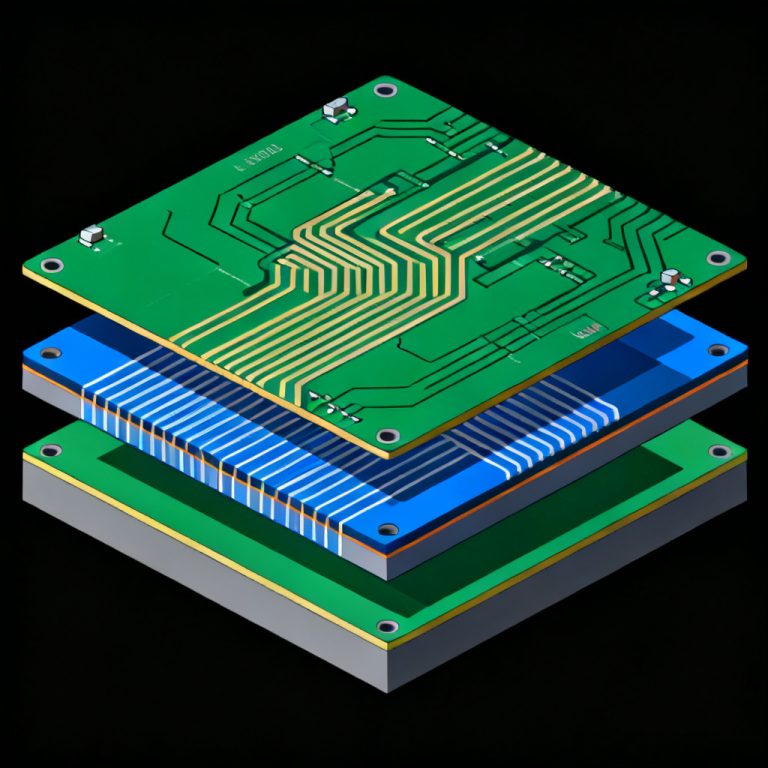
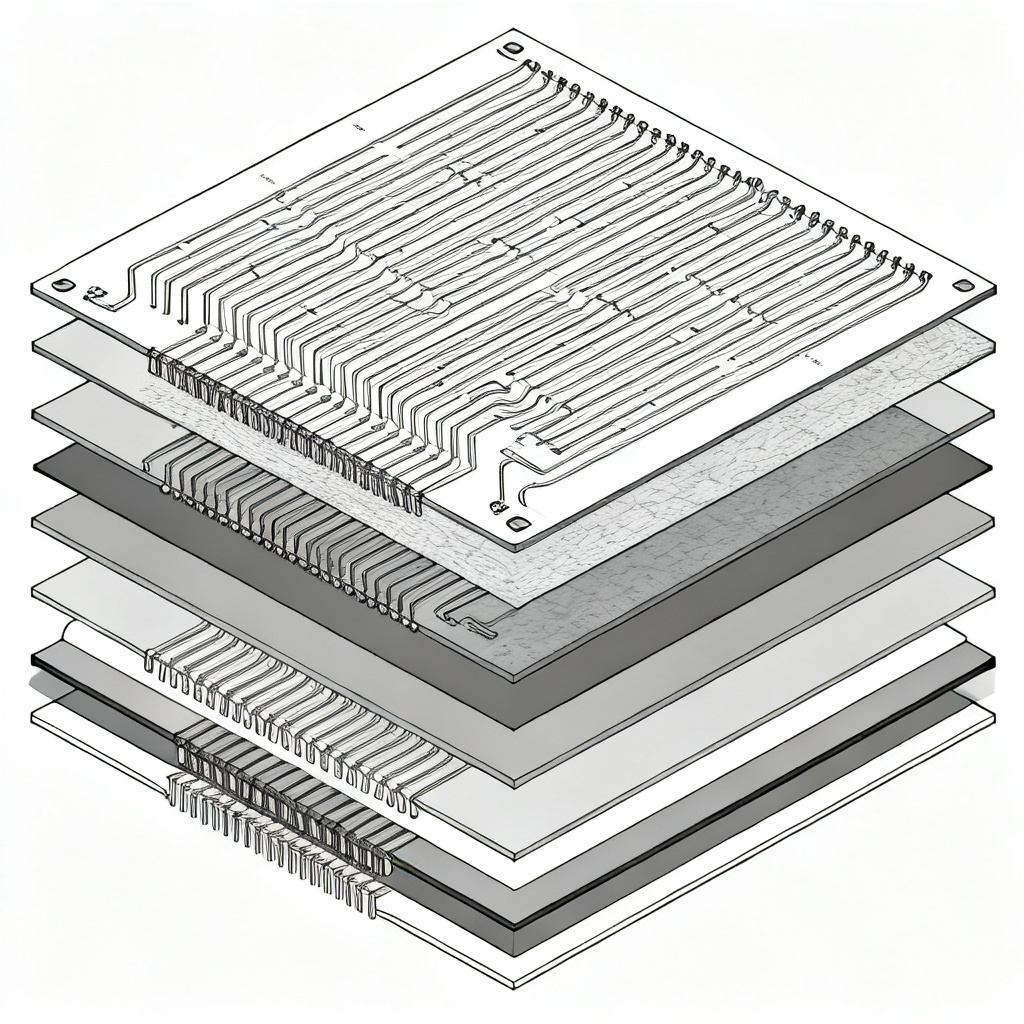
4.3 Stackup and Impedance Control
To ensure consistent characteristic impedance (Z0) and predictable propagation delay, follow these stackup guidelines:
- Use a solid reference plane: Every high-speed signal layer must be adjacent to a continuous ground or power plane.
- Control trace geometry: Maintain consistent trace width and dielectric height. Use impedance calculators (e.g., Saturn PCB Toolkit) for microstrip and stripline.
- Avoid splits in reference planes: A split plane creates a discontinuity that causes reflections and common-mode noise.
- Minimize vias: Each via adds ~0.5–1 pF of capacitance and a small inductance, creating impedance mismatches. Use back-drilling for high-speed signals.
4.4 Simulation and Verification
Before finalizing a design, simulate the transmission line behavior using tools like:
- HyperLynx (Mentor Graphics)
- SIwave (Ansys)
- Q3D Extractor (Ansys)
- SPICE (with transmission line models)
Simulate the signal at the load with the actual rise time and trace length to verify that reflections are within acceptable limits (typically <10% of signal swing for digital logic). This simulation step confirms how rise time affects reflection in transmission line designs.
5. Advanced Considerations: Beyond the Critical Length Rule
5.1 The Impact of Dielectric Material
The propagation delay (PD) depends on the dielectric constant (εr) of the PCB material:
PD = (1 / c) × √εr
Where c = speed of light (~3 × 10⁸ m/s). For FR4 (εr ≈ 4.2), PD ≈ 160 ps/inch. For low-loss materials like Rogers 4350B (εr ≈ 3.48), PD ≈ 145 ps/inch. Using a lower εr material increases the critical length for a given rise time, altering how rise time affects reflection in transmission line systems.
5.2 Rise Time Degradation Along the Trace
As a signal propagates, its rise time can degrade due to skin effect, dielectric loss, and dispersion. This is particularly important for long traces (>5 inches) at high frequencies. The critical length rule assumes the rise time at the source; in practice, the rise time at the load may be slower, reducing the need for termination. However, for reliable design, always use the fastest rise time (at the source) for critical length calculations.
5.3 Multiple Reflections and Ringing
When a trace exceeds the critical length and is not terminated, multiple reflections occur. The period of the ringing is determined by the round-trip delay of the trace. The amplitude of the ringing decays over time due to losses (conductor and dielectric). For unterminated traces longer than 2–3 times the critical length, ringing can cause false triggering, data errors, and EMI issues. This is a direct consequence of how rise time affects reflection in transmission line environments.
5.4 The “Critical Length” for Differential Signals
For differential pairs (e.g., USB, HDMI, Ethernet), the critical length rule applies to the odd-mode propagation. The differential impedance (Zdiff) must be matched to the driver and receiver. The critical length for a differential pair is similar to that of a single-ended trace with the same rise time, but the propagation delay is slightly faster due to the coupling between the traces.
6. Common Mistakes and How to Avoid Them
Mistake 1: Ignoring Rise Time and Using Clock Frequency
Many designers assume that a 50 MHz clock (period = 20 ns) does not require transmission line analysis. However, if the rise time is 2 ns (common for older logic), the critical length is ~6 inches, and a 10-inch trace will cause reflections. Always check the rise time in the datasheet.
Mistake 2: Using the Wrong Critical Length Formula
Some sources use Lcrit = tr / (10 × PD) (the one-tenth rule), while others use Lcrit = tr / (2 × PD). The one-tenth rule is more conservative and is recommended for high-reliability designs. The full formula (tr / (2 × PD)) assumes a 10% reflection tolerance. Choose based on your noise margin.
Mistake 3: Not Considering the Driver’s Output Impedance
The critical length rule assumes an ideal driver with zero output impedance. In reality, drivers have output impedance (Rdriver) that affects the reflection coefficient at the source. For CMOS drivers, Rdriver is typically 10–50 Ω. A low Rdriver reduces the need for series termination because the source already absorbs some reflections.
Mistake 4: Over-terminating Short Traces
Adding termination to a trace shorter than the critical length is unnecessary and can increase power consumption, reduce signal amplitude, and introduce additional parasitics. Use the critical length rule to decide.
7. Conclusion: The Critical Length Rule as a Design Cornerstone
The relationship between rise time and reflection in transmission lines is governed by the Critical Length Rule, which provides a clear, quantitative threshold for when a PCB trace must be treated as a transmission line. By understanding that rise time—not frequency—determines the effective bandwidth and reflection behavior, designers can avoid signal integrity pitfalls in high-speed digital systems. This understanding of how rise time affects reflection in transmission line design is essential for reliable high-speed PCB performance.
Key Takeaways:
- Always use rise time (10%–90%) to calculate critical length. Never rely solely on clock frequency.
- Use the formula Lcrit = tr / (2 × PD) for a balanced approach, or Lcrit = tr / (10 × PD) for conservative designs.
- Terminate traces that exceed the critical length. Choose series, parallel, or AC termination based on power and topology constraints.
- Simulate and verify using SI tools, especially for rise times below 1 ns.
- Consider material properties—lower εr materials increase the critical length and reduce reflection severity.
In high-speed PCB design, the critical length rule is not just a theoretical curiosity—it is a practical, actionable guideline that separates robust designs from noisy, unreliable ones. By following this rule, you ensure that your signals arrive at their destination with integrity, enabling reliable operation at high data rates.
FAQ: How Rise Time Affects Reflection in Transmission Line
What is the critical length rule for how rise time affects reflection in transmission line?
The critical length rule states that a PCB trace must be treated as a transmission line when its propagation delay exceeds one-tenth of the signal rise time. This threshold determines how rise time affects reflection in transmission line systems, preventing signal integrity issues.
How does rise time affect reflection in transmission line impedance matching?
Fast rise times generate higher frequency content, making impedance mismatches more critical. When rise time is short, reflections appear as distinct overshoot or ringing. This is why understanding how rise time affects reflection in transmission line design is vital for impedance control.
What is the formula for critical length considering rise time?
The formula is Lcrit = tr / (2 × PD), where tr is rise time and PD is propagation delay per unit length. This formula quantifies how rise time affects reflection in transmission line analysis.
Why is rise time more important than frequency for reflections?
Rise time determines the signal’s bandwidth and its interaction with trace length. Even a low-frequency clock with fast rise time can cause reflections on short traces. This is the fundamental reason how rise time affects reflection in transmission line behavior.
What termination is needed when rise time causes reflections?
Series termination at the source or parallel termination at the load is recommended when trace length exceeds the critical length. Proper termination mitigates how rise time affects reflection in transmission line designs.