Article Abstract
PCB crosstalk issues are among the most widespread and harmful signal integrity problems in modern high-speed, multi-layer, and industrial printed circuit board designs. Uncontrolled electromagnetic coupling between adjacent traces easily leads to data errors, waveform glitches, jitter rise, timing violations, and EMI compliance failures. This complete pillar guide explains what PCB crosstalk is, the difference between NEXT and FEXT, typical symptoms, root layout causes, professional testing and location methods, actionable solutions, standardized troubleshooting workflow, and a practical design prevention checklist. Compiled from Cadence, TI, and Altium industrial technical standards, this article balances professional depth for hardware engineers and easy readability for procurement and layout beginners, with optimized SEO structure and natural conversion guidance for your international website.

1. What Is PCB Crosstalk? NEXT vs FEXT Basics
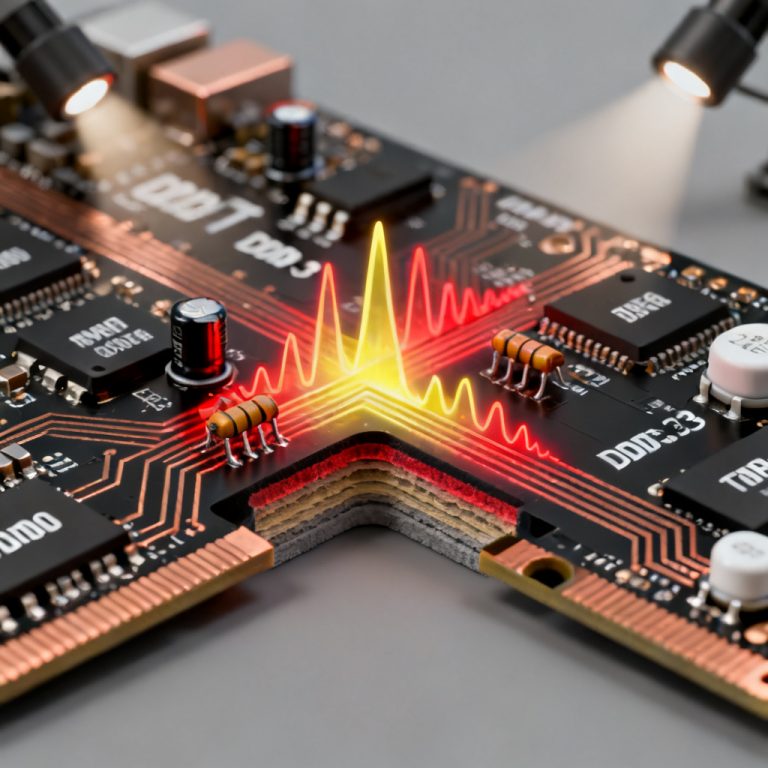
PCB crosstalk issues refer to the unintended electromagnetic energy coupling from an aggressor trace (fast switching signal) to a nearby victim trace (sensitive, low-speed, clock or analog line) through capacitive electric field coupling and inductive magnetic field coupling. As detailed in the High-speed PCB troubleshooting master page, crosstalk is one of the most common signal integrity failures in high-speed designs.
In high-density multi-layer PCBs, shorter edge rates, higher operating frequencies, and compact trace routing make PCB crosstalk issues no longer a minor analog-only issue. It becomes a main trigger for intermittent system instability, communication failure, and EMC test failure. Understanding these issues is essential for any hardware engineer.
There are two core types of PCB crosstalk issues:
- NEXT (Near-End Crosstalk): Noise couples backward to the source end of the victim trace, mainly caused by local capacitive and inductive coupling. It easily produces voltage glitches on sensitive control and reset lines.
- FEXT (Far-End Crosstalk): Noise propagates forward along the signal direction, accumulating with parallel routing length, seriously affecting clock timing and data jitter performance.
Without proper layout control, PCB crosstalk issues will reduce noise margin, trigger false logic switching, and cause unrepeatable intermittent faults that are difficult to debug in mass production. For more on related signal integrity problems, see PCB impedance issues.
2. Common Symptoms of PCB Crosstalk Problems
Identifying typical crosstalk symptoms is the first step of fast troubleshooting. Most unstable PCB performance issues can be traced to trace coupling rather than component failure or power noise. Recognizing these PCB crosstalk issues early saves significant debugging time.
| Symptom | Performance Manifestation | Main Cause | Severity |
|---|---|---|---|
| Data Bit Errors | DDR, high-speed bus communication failure, eye diagram shrinkage | Accumulated coupling noise | High |
| Random Waveform Glitches | Spurious spikes on analog and reset lines | Near-end local coupling | Medium–High |
| Increased Jitter & Timing Offset | Setup/hold time violation, clock instability | Long-distance FEXT coupling | High |
| Higher EMI Radiation | EMC test failure, external interference sensitivity | Common-mode crosstalk | Medium |
High-speed parallel buses, clock networks, analog sampling circuits, and low-level signal lines are the most vulnerable to PCB crosstalk issues. Even minor layout irregularities can lead to obvious performance degradation in mass production. For Differential Pair Routing guidelines, proper spacing is the first line of defense.
3. Root Causes of PCB Crosstalk (Layout & Stackup)
All PCB crosstalk issues originate from non-standard routing, unreasonable stackup design, and incomplete grounding. The core root causes are summarized below with clear impact mechanisms:
3.1 Insufficient Trace Spacing
Violating the 3W rule is the most common cause. When the center-to-center spacing of two traces is less than 3 times the trace width, electromagnetic field overlap increases sharply, strengthening both capacitive and inductive coupling. Ultra-high-speed and RF signals even require a 4W spacing standard.
3.2 Excessively Long Parallel Routing
Crosstalk energy accumulates linearly with parallel length. Even if spacing meets the 3W standard, long-distance parallel routing on the same layer will still cause severe FEXT interference.
3.3 Incomplete Reference Ground / Power Planes
When high-speed traces cross split ground planes or plane slots, return current paths are forced to detour, increasing loop inductance, enlarging radiation loops, and aggravating crosstalk and EMI. Proper Return Path design is essential to prevent these issues.
3.4 Interlayer Vertical Coupling
Parallel routing on adjacent upper and lower signal layers produces broadside electromagnetic coupling. Without orthogonal routing design, vertical crosstalk will continue to interfere with inner-layer signals.
3.5 Dense Via Layout
Closely arranged signal vias without ground via shielding produce parasitic capacitive coupling. Via clusters near sensitive traces become hidden crosstalk hotspots at high frequencies.
4. Professional Measurement & Fault Location Methods
Relying only on theoretical analysis cannot confirm PCB crosstalk issues. Professional time-domain, frequency-domain and near-field testing methods are necessary to locate interference sources and verify optimization effects.
4.1 Time-Domain Oscilloscope Testing
Using high-bandwidth oscilloscopes with differential probes can directly capture waveform glitches, noise amplitude, jitter changes and eye diagram closure. Engineers can simultaneously test aggressor and victim traces to distinguish NEXT and FEXT interference.
4.2 Frequency-Domain VNA Testing
Vector Network Analyzers measure S-parameters to quantify crosstalk coupling strength at different frequencies, finding resonant interference points that time-domain testing cannot easily capture, suitable for high-speed RF and serial link design.
4.3 Near-Field Scanning
Combining near-field probes and spectrum analyzers can scan the PCB surface electromagnetic field distribution, quickly locating crosstalk and EMI hotspots such as split planes, parallel trace segments and dense via areas.
For High-Speed PCB Material selection, proper material choice can also impact crosstalk susceptibility.
5. Effective Solutions to Reduce and Fix PCB Crosstalk
The following industry-proven solutions are sorted by suppression effect and implementation difficulty, suitable for new design layout and old board revision optimization. Addressing PCB crosstalk issues requires a multi-pronged approach.
| Solution | Crosstalk Suppression Effect | Implementation Difficulty | Application Scenario |
|---|---|---|---|
| Follow 3W / 4W Trace Spacing | High | Low | All high-speed, clock, analog signals |
| Shorten Parallel Routing Length | High | Medium | Long bus and clock parallel lines |
| Add Ground Guard Traces | Medium–High | Medium | Dense layout with limited space |
| Route Critical Signals on Inner Stripline | High | Low | Multi-layer PCB stackup adjustment |
| Adjacent Layer Orthogonal Routing | High | Low | Eliminate interlayer vertical coupling |
| Properly Lower Driver Slew Rate | Medium | Low | Unavoidable compact layout |
Core practical principles:
- Inner stripline routing sandwiched by complete ground planes has natural shielding, far better than outer microstrip lines.
- Ground guard traces must be connected to ground with regular stitching vias; incomplete grounding will worsen interference.
- Orthogonal routing of adjacent signal layers completely avoids vertical broadside coupling without occupying extra board space.
For PCB Manufacturing, ensure your fabricator understands your crosstalk prevention requirements.
6. Step-by-Step PCB Crosstalk Troubleshooting Flow
Follow this standardized process to avoid blind modification and quickly locate and resolve PCB crosstalk issues:
Step 1: Confirm Fault Symptoms
Record error phenomena, working frequency, temperature conditions and recurring rules.
Step 2: Locate Aggressor & Victim Pairs
Combine oscilloscope testing, near-field scanning and layout review to find interference source and sensitive lines.
Step 3: Analyze Root Layout Causes
Check spacing, parallel length, reference plane integrity, interlayer routing and via density.
Step 4: Select Targeted Fixes
Prioritize low-cost, high-efficiency measures such as adjusting spacing and shortening parallel length.
Step 5: Implement Modification & Verify
Update layout, retest waveform, signal integrity and EMI performance to confirm no new problems appear.
Many PCB crosstalk issues can be resolved at the layout stage without costly board spins.
7. PCB Crosstalk Prevention Design Checklist
Prevention is always better than post-production troubleshooting. Use this checklist to review before PCB layout finalization to avoid PCB crosstalk issues:
- Keep high-speed and sensitive signal trace spacing at least 3W; use 4W for ultra-high-speed and RF lines.
- Separate analog, low-level and reset traces far from high-speed switching buses and clock lines.
- Use grounded guard traces and via fences for critical clock signals.
- Route priority sensitive signals on inner stripline layers with complete ground planes.
- Forbid high-speed traces crossing split ground or power planes.
- Adopt 90° orthogonal routing for all adjacent signal layers.
- Add surrounding stitching ground vias for high-speed signal via clusters.
8. Key Takeaways
- PCB crosstalk issues are mainly caused by insufficient trace spacing and overlong parallel routing; following the 3W rule is the most cost-effective control method.
- NEXT causes local glitches while FEXT leads to jitter and timing errors; distinguishing the two types is critical for accurate debugging.
- Complete reference planes, inner-layer routing and orthogonal layer design are core passive suppression methods.
- Professional troubleshooting needs oscilloscope, VNA and near-field scanning to locate hidden interference hotspots.
- Design-phase prevention checklist can avoid most PCB crosstalk issues and reduce prototype rework cost.
- For complex designs, consider AI server PCB design guidelines which include advanced crosstalk management techniques.
9. FAQ About PCB Crosstalk
Q1: What is the difference between NEXT and FEXT crosstalk?
NEXT is near-end backward noise caused by local coupling; FEXT is far-end forward noise that accumulates with parallel length and mainly affects timing and jitter. Understanding this distinction is key to diagnosing PCB crosstalk issues.
Q2: Is the 3W rule mandatory for all PCB traces?
Not mandatory for low-speed DC and low-frequency control lines, but must be strictly followed for high-speed clock, data bus, analog sampling and sensitive reset signals.
Q3: Can guard traces completely eliminate crosstalk?
Guard traces can suppress most coupling interference, but they must be fully grounded with stitching vias; floating guard traces will introduce extra resonance noise.
Q4: Why does crosstalk cause EMI failure?
Crosstalk converts single-ended signals into common-mode noise, which is easily radiated through traces and vias, resulting in EMC radiation test failure.
Q5: Is inner layer routing better for crosstalk control?
Yes. Inner striplines are sandwiched by solid ground planes, with smaller electromagnetic radiation and stronger anti-crosstalk ability than outer microstrip lines.
10. Get Professional PCB Crosstalk Design & Troubleshooting Support
Still facing unresolved PCB crosstalk issues such as data errors, waveform glitches, jitter instability, or EMC radiation failure in your industrial, medical, automotive or high-speed communication PCB projects?
Our professional PCB design and signal integrity team provides one-stop crosstalk analysis, layout review, stackup optimization, simulation verification and troubleshooting consulting services. We follow Cadence, TI and Altium industrial design standards to help you eliminate PCB crosstalk issues in the design stage, reduce prototype rework, shorten development cycles and pass EMC certification smoothly.
If you need a free layout audit, technical consultation or project quotation, feel free to contact our team now. We will provide targeted professional solutions according to your PCB stackup, routing constraints and application scenarios.
📧 Contact our engineering team for expert crosstalk troubleshooting support.
Last updated: 2026