Master signal integrity for high-speed PCB design with practical transmission line reflection calculation using Excel or Python. This guide covers reflection coefficient, VSWR, and return loss for impedance matching.
Fundamentals of Transmission Line Reflection Calculation
The transmission line reflection calculation begins with the reflection coefficient formula: Γ = (ZL – Z0) / (ZL + Z0). This quantifies the ratio of reflected to incident voltage waves at a discontinuity.
Reflection Coefficient Formula and Interpretation
Key values for transmission line reflection calculation: Γ = 0 indicates perfect match (ZL = Z0), Γ = 1 means open circuit, Γ = -1 means short circuit. |Γ| > 1 suggests negative resistance, typically undesirable in passive networks.
| Parameter | Formula | Example (Z0=50Ω, ZL=75Ω) |
|---|---|---|
| Reflection Coefficient (Γ) | (ZL-Z0)/(ZL+Z0) | 0.2 |
| VSWR | (1+|Γ|)/(1-|Γ|) | 1.5 |
| Return Loss (dB) | -20log10(|Γ|) | 13.98 dB |
Voltage Standing Wave Ratio (VSWR) and Return Loss
VSWR = (1 + |Γ|) / (1 – |Γ|). For high-speed PCBs, VSWR < 1.5 is recommended. Return loss RL(dB) = -20 log10(|Γ|); higher values (e.g., >20 dB) indicate better matching.
Complex Impedance and Phase in Transmission Line Reflection Calculation
When ZL = R + jX, Γ becomes complex: Γ = ((RL + jXL) – Z0) / ((RL + jXL) + Z0). Phase angle θ_Γ = arctan(Im(Γ)/Re(Γ)).
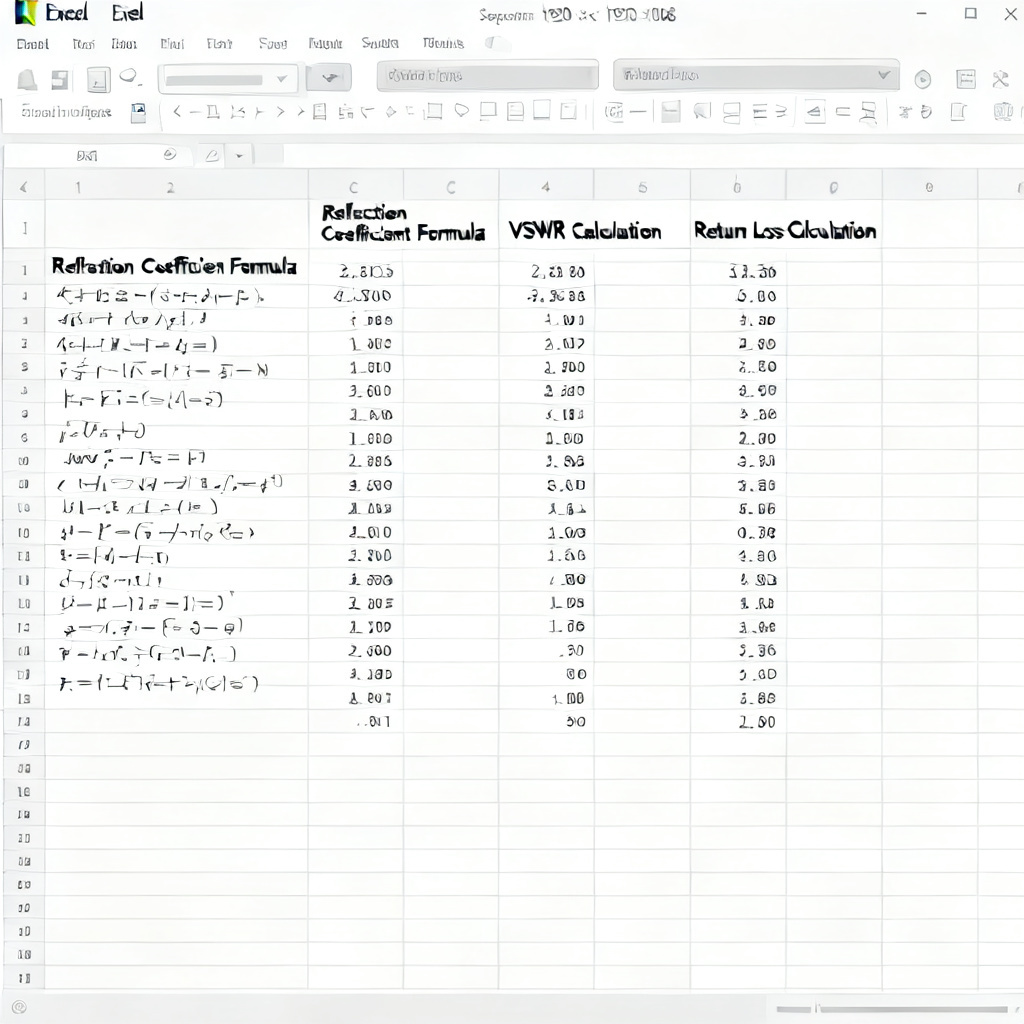
Transmission Line Reflection Calculation in Excel
Excel enables quick transmission line reflection calculation for resistive and complex loads. Follow these steps for impedance matching analysis.
Basic Resistive Load Calculation
Setup: Cell A1=”Z0 (Ω)”, B1=”ZL (Ω)”, C1=”Γ (Magnitude)”, D1=”VSWR”, E1=”Return Loss (dB)”. Input values: A2=50, B2=75. Formulas: C2=(B2-A2)/(B2+A2), D2=(1+ABS(C2))/(1-ABS(C2)), E2=-20*LOG10(ABS(C2)).
Complex Load Impedance Calculation
For ZL = 50 + j25 Ω: Use Excel’s COMPLEX, IMDIV, IMSUB, IMABS, IMARGUMENT functions. Example: D2=IMABS(IMDIV(IMSUB(COMPLEX(50,25),50),IMSUM(COMPLEX(50,25),50))) yields |Γ|=0.2425, phase=30.96°.
Frequency-Dependent Reflection
Create frequency sweep columns: A=Frequency (Hz), B=Z0(f), C=ZL, D=Γ magnitude. Example: Z0(f)=50+0.001*f, ZL=75. Drag formulas to observe Γ vs. frequency.
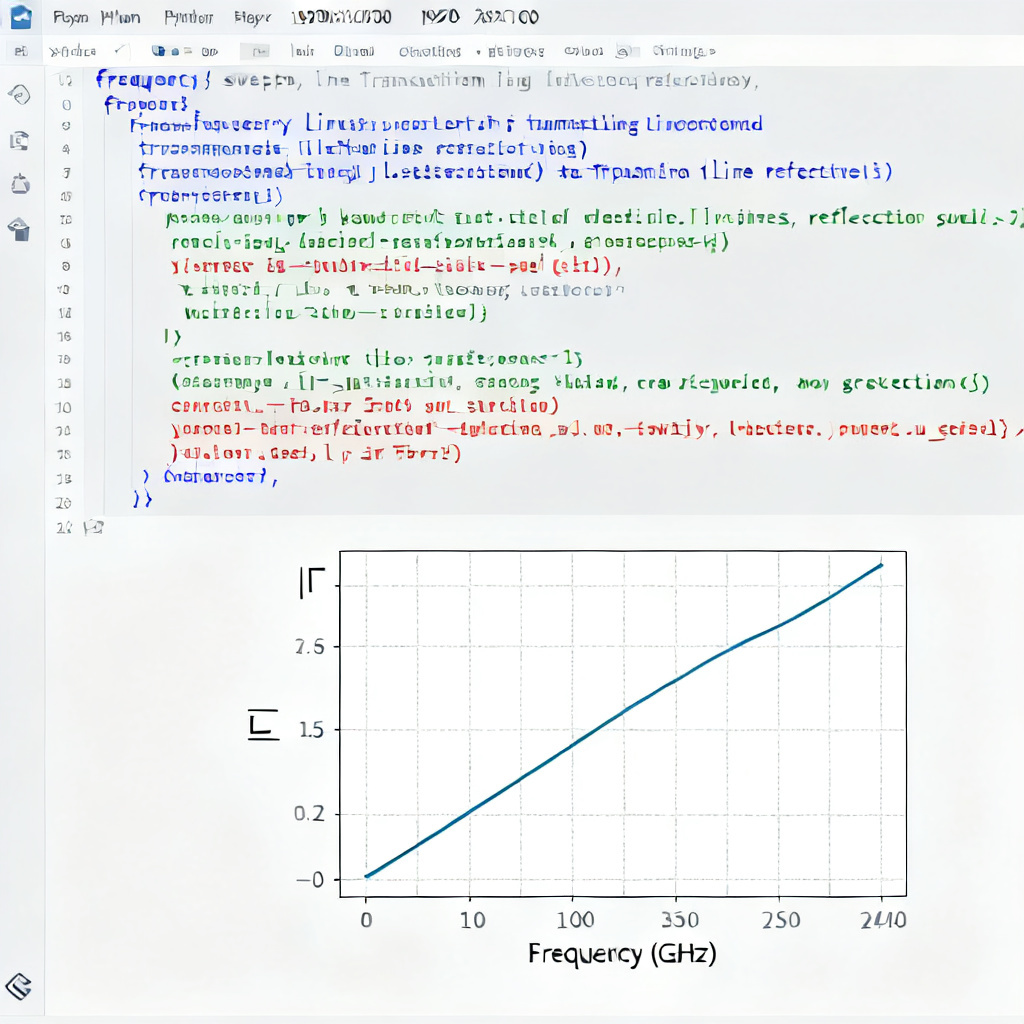
Transmission Line Reflection Calculation in Python
Python provides superior flexibility for transmission line reflection calculation, handling complex impedances, frequency sweeps, and visualization.
Basic Reflection Coefficient Function
import numpy as np
def reflection_coefficient(ZL, Z0=50):
    gamma = (ZL - Z0) / (ZL + Z0)
    return gamma
def vswr(gamma):
    mag = np.abs(gamma)
    return (1 + mag) / (1 - mag)
def return_loss(gamma):
    return -20 * np.log10(np.abs(gamma))
Frequency Sweep Analysis
Script calculates Γ across frequency range with frequency-dependent Z0 (e.g., microstrip line). Uses skin effect, inductance, capacitance, conductance models. Plots |Γ|, phase, and VSWR vs. frequency.
Smith Chart Visualization
Using scikit-rf library, generate Smith charts for comprehensive impedance matching analysis. Plot Γ values for various loads at specific frequencies.
Time Domain Reflectometry (TDR) Simulation
Simulate TDR response for single discontinuity: t, V_total, V_reflected, gamma = tdr_simulation(50, 75). Plots total voltage and reflected wave with step response.
Practical Applications for High-Speed PCB Design
Apply transmission line reflection calculation to real-world high-speed PCB scenarios.
Using Excel for Quick Impedance Matching
For differential pair (e.g., USB 3.0): Z0_diff=100Ω, ZL=50Ω → Γ = (50-100)/(50+100) = -0.333 → |Γ|=0.333 → VSWR=2.0 → RL=9.54 dB.
Python for Automated Design Optimization
Sweep termination resistor values to find best match: optimize_termination(50, np.linspace(40,60,1000)). Returns optimal ZL, |Γ|, VSWR.
Frequency-Dependent Effects in High-Speed Design
At GHz frequencies, Z0 varies due to skin effect, dielectric loss, dispersion. Use Excel frequency sweep or Python script to identify problematic resonance points.
Advanced Topics and Troubleshooting
Deepen your transmission line reflection calculation expertise with multiple discontinuities and common pitfalls.
Multiple Discontinuities
Use chain matrix (ABCD) method in Python for cascaded transmission lines (e.g., via transitions, connectors). Function cascade_reflection(Z0_segments, ZL) calculates overall Γ.
| Pitfall | Cause | Solution |
|---|---|---|
| Incorrect Z0 assumption | PCB stackup variation | Measure or simulate Z0 using field solver |
| Ignoring parasitic capacitance | Via stubs, pad capacitance | Include lumped element models in Python |
| Frequency-dependent effects | Skin effect, dielectric loss | Use frequency sweep in Python |
| Complex load not considered | Non-linear devices | Measure S-parameters with VNA |
Validating with Measurements
Cross-check with TDR (compare simulated TDR with measured waveforms) or VNA (measure S11 and compare with calculated Γ).
Frequently Asked Questions
How do I calculate transmission line reflection in Excel?
Use the formula Γ = (ZL – Z0) / (ZL + Z0) in Excel. For complex loads, use COMPLEX, IMDIV, IMSUB, IMABS, and IMARGUMENT functions for accurate transmission line reflection calculation.
What Python libraries are best for transmission line reflection calculation?
NumPy for complex number operations, Matplotlib for plotting, and scikit-rf for Smith chart visualization. These enable comprehensive transmission line reflection calculation with frequency sweeps.
Why is transmission line reflection calculation important for high-speed PCBs?
Accurate transmission line reflection calculation ensures impedance matching, minimizes signal reflections, and maintains signal integrity in high-speed digital and RF designs.
Can I use Excel for frequency-dependent reflection calculations?
Yes, create a frequency sweep column and use formulas for Z0(f). However, Python is recommended for complex frequency-dependent transmission line reflection calculation due to better handling of iterative data.
What is the relationship between reflection coefficient and VSWR?
VSWR = (1 + |Γ|) / (1 – |Γ|). VSWR = 1 indicates no reflection; higher values indicate mismatch. Both are derived from transmission line reflection calculation.