Signal reflection termination PCB design is the most critical method to eliminate overshoot, undershoot and ringing in high-speed digital systems. Mastering signal reflection termination PCB techniques ensures reliable data transmission. This comprehensive guide covers PCB signal reflection causes, reflection coefficient calculation, critical length rule, and four proven high speed PCB termination methods for perfect signal integrity termination.
This signal reflection termination PCB guide is part of our Signal Integrity Guide.
Table of Contents
- 1. What Is Signal Reflection in High-Speed PCB
- 2. How Signal Reflection Occurs & Reflection Coefficient Theory
- 3. Typical Reflection Waveforms & Common Fault Symptoms
- 4. Critical Trace Length: When PCB Termination Is Mandatory
- 5. Four Mainstream Termination Methods for High-Speed PCB
- 6. Termination Methods Comparison Quick Reference Chart
- 7. PCB Termination Placement & Layout Design Rules
- 8. Troubleshooting Common Signal Reflection Issues
- 9. Termination Requirements for Popular High-Speed Protocols
- 10. Key Takeaways & Design Best Practices
- 11. FAQ About PCB Signal Reflection and Termination
- 12. Get Professional PCB SI Design & Termination Solution
What Is Signal Reflection in High-Speed PCB?
Signal reflection termination PCB issues begin with understanding the underlying phenomenon. PCB signal reflection is a core signal integrity (SI) phenomenon that happens when high-speed electromagnetic signals travel along PCB transmission lines and encounter impedance discontinuity. At any point where characteristic impedance changes, part of the signal energy cannot transmit to the receiver and reflects back toward the driver end. Understanding signal reflection termination PCB is essential for every hardware engineer.
A simple physical analogy is light traveling from air into water: one part refracts into the medium, while another part reflects back. The same wave propagation principle applies to high-speed digital signals on PCB traces. Uncontrolled PCB signal reflection leads to severe waveform degradation that compromises system reliability.
Uncontrolled PCB signal reflection leads to severe waveform degradation, including:
- Overshoot – voltage exceeding normal high level
- Undershoot – voltage dropping below normal low level
- Ringing oscillation – repeated up-and-down after edge
- Staircase edge distortion – step-like rising/falling edge
These waveform problems further cause reduced timing margin, sampling error, increased bit error rate, intermittent system reboot, and even permanent IC latch-up damage in severe cases. Proper high speed PCB termination design is the most cost-effective and reliable solution to suppress reflection and stabilize signal integrity termination performance. Implementing correct signal reflection termination PCB techniques prevents these issues at the source.
For a deeper understanding of impedance fundamentals that affect reflection, refer to our Impedance Matching Ultimate Guide.
How Signal Reflection Occurs & Reflection Coefficient Theory
2.1 Why Impedance Matching Is Essential
High-speed signals propagate as electromagnetic waves rather than simple DC current. For clean, distortion-free transmission, the characteristic impedance (Z₀) of the entire trace path must remain consistent from driver to receiver. When planning signal reflection termination PCB strategy, identifying impedance discontinuity points is the first step in effective signal integrity termination design.
Common impedance discontinuity points that trigger PCB signal reflection issues:
- Layer changing vias and via residual stubs
- Component pad width sudden change
- Connector interface impedance mismatch
- Branch traces and unused stubs
- Split power/ground planes without complete return path
Any break in impedance continuity creates a reflection boundary, causing signals to bounce back and forth repeatedly between driver and receiver. Understanding reflection coefficient PCB values helps quantify this effect and guides signal reflection termination PCB optimization.
For guidance on reference plane continuity and return path integrity, see our Return Path Design Guide.
2.2 Reflection Coefficient Formula & Physical Meaning
The reflection coefficient PCB (Γ) quantitatively describes the proportion of reflected signal energy at impedance junctions. This is a fundamental concept in signal reflection termination PCB analysis:
Γ = (Z₂ - Z₁) / (Z₂ + Z₁)
Where:
- Z₁ = Original trace characteristic impedance
- Z₂ = Impedance of the next segment
Three ideal boundary conditions for signal reflection termination PCB analysis:
| Condition | Γ Value | Reflection Type | Waveform Effect |
|---|---|---|---|
| Open circuit | Γ = +1 | Total positive reflection | Severe overshoot |
| Perfect match | Γ = 0 | No reflection | Ideal transmission |
| Short circuit | Γ = -1 | Total negative reflection | Severe undershoot |
2.3 Reflection Coefficient Standard & Design Tolerance
Controlling Γ within a reasonable range is the core SI design target for high speed PCB termination. Proper signal reflection termination PCB design maintains Γ below 0.1:
| Reflection Coefficient Γ | Overshoot Amplitude | Design Evaluation |
|---|---|---|
| < 0.05 | < 5% signal swing | ✅ Perfect, fully compliant |
| 0.05 ~ 0.1 | 5% ~ 10% signal swing | 🟡 Acceptable for general industrial design |
| > 0.1 | > 10% signal swing | ❌ Must optimize impedance and termination |
When Γ exceeds 0.1, overshoot and undershoot may exceed chip absolute maximum rating, leading to long-term reliability risks. This is why signal reflection termination PCB design cannot be an afterthought.
Typical Reflection Waveforms & Common Fault Symptoms
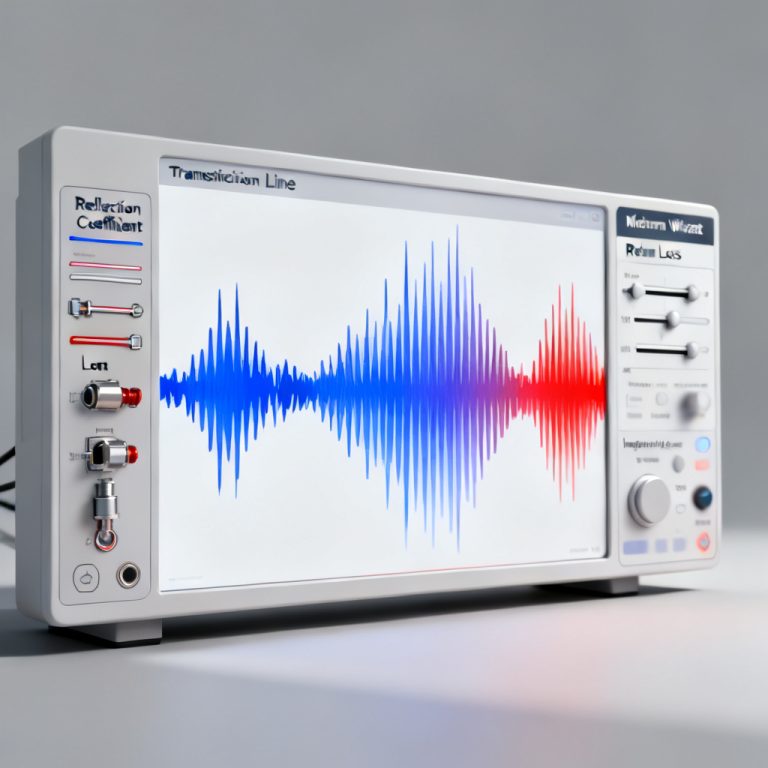
Engineers can quickly judge reflection types and root causes directly through oscilloscope waveform observation when debugging signal reflection termination PCB designs:
| Fault Type | Waveform Feature | Main Causes |
|---|---|---|
| Overshoot | Voltage exceeds VOH then gradually settles | Low driver output impedance, open-type reflection |
| Undershoot | Voltage drops below VOL then recovers | High driver output impedance, short-circuit reflection |
| Ringing | Continuous up-and-down oscillation after signal edge | Long unterminated traces, repeated reflection |
| Staircase Waveform | Step-like rising / falling edge | Extra stub lines, branch traces, multi-section mismatch |
For crosstalk-induced waveform distortion that may compound reflection issues, see our Crosstalk Guide.
Critical Trace Length: When PCB Termination Is Mandatory
Not all PCB traces need termination. The core judgment rule for high speed PCB termination and signal reflection termination PCB design:
Termination is required when trace physical length exceeds 1/6 of the signal rising edge spatial length. This critical length rule is fundamental to signal integrity termination planning.
Industry universal empirical formula for critical length:
L_critical (inch) ≈ tr (ns) × 1.5
| Signal Rise Time tr | Critical Length | Termination Rule |
|---|---|---|
| 1.0 ns | 1.5 inch | Trace over 1.5″ must add termination |
| 0.5 ns | 0.75 inch | Trace over 0.75″ needs termination |
| 0.3 ns | 0.45 inch | Surface trace over 0.4″ requires termination |
| 0.1 ns | 0.15 inch | Almost all high-speed traces need termination |
With faster interface speeds such as PCIe, DDR5 and Gigabit Ethernet, signal rise time becomes shorter, making high speed PCB termination a standard design practice rather than optional. Proper signal reflection termination PCB implementation starts with this critical length calculation.
Four Mainstream Termination Methods for High-Speed PCB
Choosing the right termination method is essential for effective signal reflection termination PCB design. Each method serves different application needs within high speed PCB termination strategy.
5.1 Series Termination
| Parameter | Specification |
|---|---|
| Placement | Close to driver output pin |
| Resistance calculation | Rs = Z₀ – R_out |
| Standard typical value | 22Ω, 33Ω, 47Ω |
Advantages: Extremely low DC power consumption, simple circuit, no steady-state current loss. Disadvantages: Only suitable for point-to-point topology, slightly increases signal rise/fall time. Application: High-speed clock, SPI, USB 3.x, single-ended signals. Series termination is often the first choice for signal reflection termination PCB due to its simplicity and low power consumption.
5.2 Parallel Termination
| Parameter | Specification |
|---|---|
| Placement | Near receiver input pin |
| Resistance | Equal to Z₀ |
| Connection | Pull-up to VCC or pull-down to GND |
Advantages: Fully absorbs reflected wave, excellent waveform smoothing. Disadvantages: High static power consumption. Application: Fixed level clock signal, point-to-point high-speed lines.
5.3 Thevenin Termination
| Parameter | Specification |
|---|---|
| Structure | R1 pull-up to VCC, R2 pull-down to GND |
| Design rule | Parallel resistance of R1 and R2 = Z₀; Equivalent Thevenin voltage = VCC/2 |
Advantages: Flexible DC bias level, supports bidirectional bus and multi-drop topology. Disadvantages: Occupies more PCB area, high power consumption. Application: DDR address/command bus, multi-point shared bus.
5.4 AC (RC) Termination
| Parameter | Specification |
|---|---|
| Structure | Resistor + Capacitor series near receiver |
| Parameter selection | R = Z₀, C = 100~500pF |
Advantages: Capacitor blocks DC current → ultra-low power loss, perfect for periodic clock signals. Disadvantages: Minor signal delay, capacitor value needs debugging. Application: High-speed differential clock, periodic reference signal. AC termination provides excellent signal reflection termination PCB performance with minimal power loss.
For differential pair termination considerations, see our Differential Pair Routing Guide.
Termination Methods Comparison Quick Reference Chart
| Termination Type | Power Consumption | Topology Suitability | Debug Difficulty | Best Application |
|---|---|---|---|---|
| Series | Extremely Low | Point-to-Point | Easy | Clock, SPI, USB3 |
| Parallel | High | Point-to-Point | Easy | Fixed-level single-ended |
| Thevenin | High | Point-to-Point / Multi-drop | Moderate | DDR bus, multi-node |
| AC RC | Low | Point-to-Point | Moderate | High-speed periodic clock |
PCB Termination Placement & Layout Design Rules
Correct resistance value cannot guarantee good effect — placement distance directly determines signal integrity termination performance. Following proper placement rules is critical for successful signal reflection termination PCB implementation.
| Termination Type | Layout Placement Requirement |
|---|---|
| Series | 200~500 mil within driver pin |
| Parallel | 200~500 mil within receiver pin |
| Thevenin | Placed tightly near receiver end |
| AC RC | Close to receiver input pin |
Universal Hard Rule for high speed PCB termination and signal reflection termination PCB: All termination resistors must be placed within 500 mil (12.7mm) of the corresponding driver or receiver pin. Excess routing between resistor and pin will form new stubs and cause secondary reflection, completely defeating the purpose of signal integrity termination.
Additional layout principles:
- Minimize trace stubs and branch lines
- Avoid high-speed traces crossing split power/ground planes
- Add stitching vias to repair interrupted return path
- Use back-drilling to eliminate via residual stubs for high-speed layers
Troubleshooting Common Signal Reflection Issues
8.1 Standard Debug Workflow
- Capture real signal waveform with high-bandwidth oscilloscope
- Classify fault: overshoot, undershoot, ringing or staircase edge
- Check existing termination type, resistance value and placement
- If no termination, test add series 33Ω resistor first as a basic signal reflection termination PCB solution
- If termination exists, adjust resistance ±10%~20% and retest
- Use TDR impedance testing to locate impedance discontinuity points
8.2 Common Root Causes & Solutions
| Problem Root Cause | Troubleshooting & Optimization Method |
|---|---|
| Extra stub & branch traces | Shorten stubs, remove unused branch routing |
| Long via residual stub | Adopt back-drilling manufacturing process |
| Connector impedance mismatch | Select high-speed dedicated matched connector |
| Power/ground plane split | Avoid crossing split area; add stitching vias |
For eye diagram analysis to verify termination effectiveness, see our Eye Diagram and Jitter Analysis Guide.
Termination Requirements for Popular High-Speed Protocols
| Protocol | Recommended Termination | Standard Impedance |
|---|---|---|
| PCIe | On-die ODT termination | 100Ω differential |
| DDR4 / DDR5 | On-die ODT + VTT termination | 40~60Ω single-ended |
| USB 3.x | Optional 33Ω series resistor | 90Ω differential |
| Ethernet | 100Ω parallel differential termination | 100Ω |
| General Clock | 33Ω series termination | 50Ω single-ended |
| High-Speed SPI | 22~33Ω series resistor | 50Ω single-ended |
Key Takeaways & Design Best Practices
- Signal reflection is fundamentally caused by impedance discontinuity on PCB transmission lines
- The faster the signal rise time, the shorter the critical length, the more necessary high speed PCB termination becomes
- Proper signal reflection termination PCB design starts with calculating critical trace length
- Series termination is the first choice for low power consumption; Thevenin is ideal for multi-drop bus
- Keep all termination components within 500 mil of driver/receiver pins to avoid new reflection
- Judge reflection fault type via oscilloscope waveform, optimize resistance and layout step by step
- Follow protocol standard impedance and termination rules to reduce prototype rework
- Effective signal integrity termination requires both correct resistance value AND proper placement
Return to the Signal Integrity Guide for more coverage of impedance control, return path design, differential pairs, crosstalk, and eye diagram analysis.
FAQ About PCB Signal Reflection and Termination
Q1: What is the main cause of signal reflection termination PCB issues?
The core reason is impedance discontinuity from vias, connectors, stubs, pad width change and split power/ground planes. Proper signal reflection termination PCB design addresses these discontinuities at the source.
Q2: Do all high-speed traces need termination for signal reflection termination PCB?
No. Only when trace length exceeds 1/6 rise edge spatial length is high speed PCB termination required. Short traces with slow rise time can omit termination. Calculate critical length first.
Q3: Which termination method has the lowest power consumption for signal reflection termination PCB?
Series termination and AC RC termination have the lowest DC power loss; parallel and Thevenin consume more static power for signal integrity termination.
Q4: Why must termination resistors be placed within 500 mil for signal reflection termination PCB?
Too long routing between resistor and pin forms a new stub, creating new impedance discontinuity and completely invalidating the termination effect. This is a hard rule in signal reflection termination PCB design.
Q5: How to fix ringing waveform in signal reflection termination PCB design?
Add series 22~33Ω resistor at driver end, shorten trace length, remove extra stubs and ensure complete ground return path. These are proven signal reflection termination PCB solutions.
Get Professional Signal Reflection Termination PCB Design Support
Are you struggling with signal overshoot, ringing, unstable high-speed interface or unclear termination resistance selection? Our professional high speed PCB termination and signal reflection termination PCB team provides one-stop technical services.
We offer: Free signal reflection termination PCB consultation • PCB design review • TDR impedance testing • Reflection fault positioning • Custom termination for PCIe/DDR/USB/Ethernet/clock
All design files strictly confidential. Response within one business day.
About HighSpeedPCBs.com
We are a specialized PCB design and manufacturing service provider serving industrial, automotive, medical, and communications OEMs worldwide. Our expertise in signal reflection termination PCB design ensures your high-speed interfaces perform reliably.
© 2026 HighSpeedPCBs.com — Professional High-Speed PCB Solutions